
ISO 14001:2026 Environmental management systems — Requirements with guidance for use #
Foreword #
ISO (the International Organization for Standardization) is a worldwide federation of national standards bodies (ISO member bodies). The work of preparing International Standards is normally carried out through ISO technical committees. Each member body interested in a subject for which a technical committee has been established has the right to be represented on that committee. International organizations, governmental and non-governmental, in liaison with ISO, also take part in the work. ISO collaborates closely with the International Electrotechnical Commission (IEC) on all matters of electrotechnical standardization. The procedures used to develop this document and those intended for its further maintenance are described in the ISO/IEC Directives, Part 1. In particular, the different approval criteria needed for the different types of ISO document should be noted. This document was drafted in accordance with the editorial rules of the ISO/IEC Directives, Part 2 (see www.iso.org/directives). ISO draws attention to the possibility that the implementation of this document may involve the use of (a) patent(s). ISO takes no position concerning the evidence, validity or applicability of any claimed patent rights in respect thereof. As of the date of publication of this document, ISO had not received notice of (a) patent(s) which may be required to implement this document. However, implementers are cautioned that this may not represent the latest information, which may be obtained from the patent database available at www.iso.org/patents. ISO shall not be held responsible for identifying any or all such patent rights. Any trade name used in this document is information given for the convenience of users and does not constitute an endorsement. For an explanation of the voluntary nature of standards, the meaning of ISO specific terms and expressions related to conformity assessment, as well as information about ISO’s adherence to the World Trade Organization (WTO) principles in the Technical Barriers to Trade (TBT), see www.iso.org/iso/foreword.html. This document was prepared by Technical Committee ISO/TC 207, Environmental management, Subcommittee SC 1, Environmental management systems, in collaboration with the European Committee for Standardization (CEN) Technical Committee, in accordance with the Agreement on technical cooperation between ISO and CEN (Vienna Agreement). This fourth edition cancels and replaces the third edition (ISO 14001:2015), which has been technically revised. It also replaces the Amendment ISO 14001:2015/Amd 1:2024. The main changes are as follows:
— incorporation of latest ISO requirements for management system standards as appropriate;
— clarification of requirements associated with key topics.
Any feedback or questions on this document should be directed to the user’s national standards body. A complete listing of these bodies can be found at www.iso.org/members.html.
Introduction #
0.1 Background #
Achieving a balance between the environment, society and the economy is considered essential to meet the needs of the present without compromising the ability of future generations to meet their needs. Sustainable development as a goal is achieved by balancing the three pillars of sustainability. Societal expectations for sustainable development, transparency and accountability have evolved with increasingly stringent legislation and growing pressures on the environment from pollution, inefficient use of resources, improper waste management, climate change, degradation of ecosystems and loss of biodiversity. Undermining the environment can carry financial, social and business consequences, not just environmental implications. These expectations have led organizations to adopt a systematic approach to environmental management by implementing environmental management systems with the aim of contributing to the environmental pillar of sustainability. As a result, organizations are better positioned to respond to the needs and expectations of interested parties and to meet the organization’s compliance obligations.
0.2 Aim of an environmental management system #
This document provides organizations with a framework to protect the environment and respond to changing environmental conditions in balance with socio-economic needs. It specifies requirements that enable an organization to achieve the intended outcomes it sets for its environmental management system. A systematic approach to environmental management provides top management with information to build success over the long term and create options for contributing to sustainable development by:
— protecting the environment through preventing or mitigating adverse environmental impacts;
— mitigating the potential adverse effect of environmental conditions on the organization;
— assisting the organization to meet its compliance obligations;
— enhancing environmental performance;
— controlling or influencing the way the organization’s products and services are designed, manufactured,
distributed, consumed and disposed of by using a life cycle perspective that prevents adverse environmental impacts from being unintentionally shifted elsewhere within the life cycle;
— achieving financial and operational benefits that result from implementing environmentally sound
alternatives that strengthen the organization’s market position;
— communicating environmental information to relevant interested parties.
0.3 Success factors #
The success of an environmental management system depends on commitment from all levels and functions of the organization, led by top management. Organizations can leverage opportunities to prevent or mitigate adverse environmental impacts and enhance beneficial environmental impacts, particularly those with strategic and competitive advantages. Top management can effectively address its risks and opportunities by integrating environmental management into the organization’s business processes, strategic direction and decision-making, aligning them with other business priorities, and incorporating environmental governance into its overall management system. Demonstration of successful implementation of this document can be used to assure interested parties that an effective environmental management system is in place. Adoption of the requirements in this document, however, will not in itself guarantee optimal environmental outcomes. Application of the requirements in this document can differ from one organization to another due to the context of the organization. Two organizations can carry out similar activities but can have different compliance obligations, commitments in their environmental policy, environmental technologies and environmental performance goals, yet both can conform to the requirements of this document. The level of detail and complexity of the environmental management system will vary depending on the context of the organization, the scope of its environmental management system, its compliance obligations, and the nature of its activities, products and services, including its environmental aspects and associated environmental impacts.
0.4 Plan-Do-Check-Act model #
The basis for the approach underlying an environmental management system is founded on the concept of Plan-Do-Check-Act (PDCA). The PDCA model provides an iterative process used by organizations to achieve continual improvement. It can be applied to an environmental management system and to each of its individual elements. It is briefly described as follows:
— Plan: Establish environmental objectives and processes necessary to deliver results in accordance with
the organization’s environmental policy.
— Do: Implement the processes as planned.
— Check: Monitor and measure processes against the environmental policy, including its commitments, environmental objectives and operating criteria, and report the results.
— Act: Take actions to continually improve.
Figure 1 shows how the framework used in this document can be integrated into a PDCA model, which can help new and existing users to understand the importance of a systems approach.
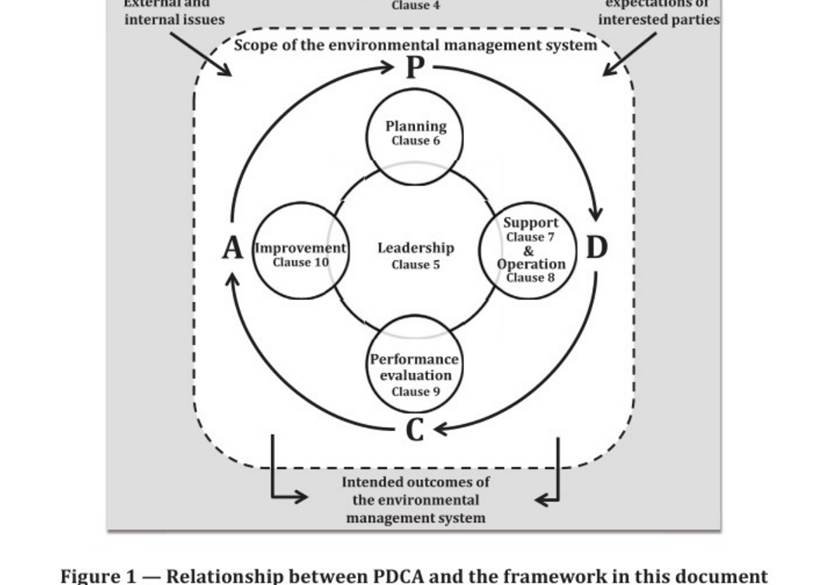
Figure 1 — Relationship between PDCA and the framework in this document
0.5 Contents of this document #
This document conforms to ISO requirements for management system standards. These requirements include a harmonized structure, identical core text and common terms with core definitions, designed to benefit users implementing multiple ISO management system standards. This document does not include requirements specific to other management systems, such as those for quality, occupational health and safety, energy or financial management. However, this document enables an organization to use a common approach and risk-based thinking to integrate its environmental management system with the requirements of other management systems. This document contains the requirements used to assess conformity. An organization that wishes to demonstrate conformity with this document can do so by:
— making a self-determination and self-declaration; or
— seeking confirmation of its conformance by parties having an interest in the organization, such as
customers; or
— seeking confirmation of its self-declaration by a party external to the organization; or
— seeking certification/registration of its environmental management system by an external organization.
Annex A (informative) #
document. Guidance on applying the ISO 14001 framework to specific environmental topic areas is addressed in the ISO 14002 series. Implementation guidance on environmental management systems is included in ISO 14004. Clause A.3 provides further insights on specific words and phrases used in this document to enhance the understanding of concepts that are relevant to an environmental management system.
Environmental management systems — Requirements with guidance for use #
Environmental management systems — Requirements with guidance for use
1 Scope #
This document specifies the requirements for an environmental management system that an organization can use to enhance its environmental performance. It is intended for use by an organization seeking to manage its environmental responsibilities in a systematic manner that contributes to the environmental pillar of sustainability. This document helps an organization to achieve the intended outcomes of its environmental management system, which provide value for the environment, the organization itself and interested parties. The intended outcomes of an environmental management system include:
— enhancing environmental performance;
— meeting compliance obligations;
— achieving environmental objectives.
This document is applicable to any organization, regardless of size, type or nature, and applies to the environmental aspects of its activities, products and services that the organization determines it can either control or influence considering a life cycle perspective. This document does not state specific environmental performance criteria. This document can be used in whole or in part to systematically improve environmental management. Claims of conformity to this document, however, are not acceptable unless all its requirements are incorporated into an organization’s environmental management system and fulfilled without exclusion.
2 Normative references #
There are no normative references in this document.
3 Terms and definitions #
For the purposes of this document, the following terms and definitions apply. ISO and IEC maintain terminology databases for use in standardization at the following addresses:
— ISO Online browsing platform: available at https://www.iso.org/obp
— IEC Electropedia: available at https://www.electropedia.org/
3.1 Terms related to organization and leadership #
3.1.1 management system #
set of interrelated or interacting elements of an organization (3.1.5) to establish policies (3.1.3) and objectives (3.2.5) as well as processes (3.3.4) to achieve those objectives
Note 1 to entry: A management system can address a single discipline or several disciplines.
EXAMPLE Quality, environment, occupational health and safety, energy or financial management.
Note 2 to entry: The management system elements include the organization’s structure, roles and responsibilities,
planning and operation.
Note 3 to entry: The scope of a management system can include the whole of the organization, specific and identified
functions of the organization, specific and identified sections of the organization, or one or more functions across a group of organizations.
3.1.2 environmental management system #
part of the management system (3.1.1) used to manage environmental aspects (3.2.2), meet compliance obligations (3.2.9) and address risks and opportunities (3.2.10)
Note 1 to entry: The environmental management system elements include: context of the organization (Clause 4),
leadership (Clause 5), planning (Clause 6), support (Clause 7), operation (Clause 8), performance evaluation (Clause 9) and improvement (Clause 10).
3.1.3 policy #
intentions and direction of an organization (3.1.5) as formally expressed by its top management (3.1.6)
3.1.4 environmental policy #
policy (3.1.3) related to environmental performance (3.4.11)
3.1.5 organization #
person or group of people that has its own functions with responsibilities, authorities and relationships to achieve its objectives (3.2.5)
Note 1 to entry: The concept of organization includes, but is not limited to, sole-trader, company, corporation, firm,
enterprise, authority, partnership, charity or institution, or part or combination thereof, whether incorporated or not, public or private.
Note 2 to entry: If the organization is part of a larger entity, the term “organization” refers only to the part of the larger
entity that is within the scope of the environmental management system (3.1.2).
3.1.6 top management #
person or group of people who directs and controls an organization (3.1.5) at the highest level
Note 1 to entry: Top management has the power to delegate authority and provide resources within the organization.
Note 2 to entry: If the scope of the management system (3.1.1) covers only part of an organization, then top management
refers to those who direct and control that part of the organization.
3.1.7 interested party (preferred term) #
stakeholder (admitted term) person or organization (3.1.5) that can affect, be affected by, or perceive itself to be affected by a decision or activity EXAMPLE Customers, communities, suppliers, regulators, non-governmental organizations, investors and employees.
Note 1 to entry: To “perceive itself to be affected” means the perception has been made known to the organization.
3.2 Terms related to planning #
3.2.1 environment #
surroundings in which an organization (3.1.5) operates, including air, water, land, natural resources, flora, fauna, humans and their interrelationships
Note 1 to entry: Surroundings can extend from within an organization to the local, regional and global system.
Note 2 to entry: Surroundings can be described in terms of biodiversity, ecosystems, climate or other characteristics.
3.2.2 environmental aspect #
element of an organization’s (3.1.5) activities or products or services that interacts or can interact with the environment (3.2.1)
Note 1 to entry: An environmental aspect can cause (an) environmental impact(s) (3.2.4). A significant environmental aspect is one that has or can have one or more significant environmental impact(s).
Note 2 to entry: Significant environmental aspects are determined by the organization applying established criteria.
3.2.3 environmental condition #
state or characteristic of the environment (3.2.1) as determined at a certain point in time
3.2.4 environmental impact #
change to the environment (3.2.1), whether adverse or beneficial, wholly or partially resulting from an organization’s (3.1.5) environmental aspects (3.2.2)
3.2.5 objective #
result to be achieved
Note 1 to entry: An objective can be strategic, tactical, or operational.
Note 2 to entry: Objectives can relate to different disciplines (such as finance, health and safety, and environment
(3.2.1)). They can be, for example, organization-wide or specific to a project, product, service or process (3.3.4).
Note 3 to entry: An objective can be expressed in other ways, e.g. as an intended result, as a purpose, as an operational criterion, as an environmental objective (3.2.6) or by the use of other words with similar meaning (e.g. aim, goal, or target).
Note 4 to entry: In the context of environmental management systems (3.1.2), environmental objectives are set by the organization (3.1.5), consistent with the environmental policy (3.1.4), to achieve specific results.
3.2.6 environmental objective #
objective (3.2.5) set by the organization (3.1.5) consistent with its environmental policy (3.1.4) 3:27 prevention of pollution use of processes (3.3.4), practices, techniques, materials, products, services or energy to avoid, reduce or control (separately or in combination) the creation, emission or discharge of any type of pollutant or waste, in order to reduce adverse environmental impacts (3.2.4)
Note 1 to entry: Prevention of pollution can include source reduction or elimination; process, product or service
changes; efficient use of resources; material and energy substitution; reuse; recovery; recycling; reclamation; or treatment.
3.2.8 requirement #
need or expectation that is stated, generally implied or obligatory
Note 1 to entry: “Generally implied” means that it is custom or common practice for the organization (3.1.5) and
interested parties (3.1.7) that the need or expectation under consideration is implied.
Note 2 to entry: A specified requirement is one that is stated, e.g. in documented information (3.3.2).
3.2.9 compliance obligations (preferred term) #
legal requirements and other requirements (admitted term) legal requirements (3.2.8) that an organization (3.1.5) has to comply with and other requirements that an organization has to or chooses to comply with
Note 1 to entry: Compliance obligations are related to the environmental management system (3.1.2).
Note 2 to entry: Compliance obligations can arise from mandatory requirements, such as applicable laws and
regulations, or voluntary commitments, such as organizational and industry standards, contractual relationships, codes of practice and agreements with community groups, non-governmental organizations, or other interested parties (3.1.7).
3.2.10 risks and opportunities #
potential adverse effects (i.e. risks) and potential beneficial effects (i.e. opportunities) 3.3. Terms related to support and operation
3.3.1 competence #
ability to apply knowledge and skills to achieve intended results
3.3.2 documented information #
information required to be controlled and maintained by an organization (3.1.5) and the medium on which it is contained
Note 1 to entry: Documented information can be in any format and media and from any source.
Note 2 to entry: Documented information can refer to:
— the management system (3.1.1), including related processes (3.3.4);
— information created in order for the organization to operate (documentation);
— evidence of results achieved (records).
3.3.3 life cycle #
consecutive and interlinked stages of a product (or service) system, from raw material acquisition or generation from natural resources to final disposal
Note 1 to entry: The life cycle stages include acquisition of raw materials, design, production, transportation/delivery,
use, end-of-life treatment and final disposal.
[SOURCE: ISO 14044:2006, 3.1, modified — “(or service)” added to the definition. Note 1 to entry added.]
3.3.4 process #
set of interrelated or interacting activities that uses or transforms inputs to deliver a result
Note 1 to entry: Whether the result of a process is called an output, a product or a service depends on the context of
the reference.
Note 2 to entry: A process can be documented or not.
3.4 Terms related to performance evaluation and improvement #
3.4.1 audit #
systematic and independent process (3.3.4) for obtaining evidence and evaluating it objectively to determine the extent to which the audit criteria are fulfilled
Note 1 to entry: An audit can be an internal audit (first party) or an external audit (second party or third party), and it
can be a combined audit (combining two or more disciplines).
Note 2 to entry: An internal audit is conducted by the organization (3.1.5) itself, or by an external party on its behalf.
Note 3 to entry: “Audit evidence” and “audit criteria” are defined in ISO 19011.
Note 4 to entry: Independence can be demonstrated by freedom from responsibility for the activity being audited or
freedom from bias and conflict of interest.
3.4.2 conformity #
fulfilment of a requirement (3.2.8)
3.4.3 nonconformity #
non-fulfilment of a requirement (3.2.8)
Note 1 to entry: Nonconformity relates to requirements in this document and additional environmental management
system (3.1.2) requirements that an organization (3.1.5) establishes for itself.
3.4.4 corrective action #
action to eliminate the cause(s) of a nonconformity (3.4.3) and to prevent recurrence
3.4.5 continual improvement #
recurring activity to enhance performance (3.4.10)
Note 1 to entry: Enhancing performance relates to the use of the environmental management system (3.1.2) to enhance
environmental performance (3.4.11) consistent with the organization’s (3.1.5) environmental policy (3.1.4).
Note 2 to entry: The activity does not have to take place in all areas simultaneously or without interruption.
3.4.6 effectiveness #
extent to which planned activities are realized and planned results are achieved
3.4.7 indicator #
quantitative, qualitative or binary variable that can be measured or described, representing the status of operations, management, conditions or impacts
(SOURCE: ISO 14031:2021, 3.4.1]
3.4.8 monitoring #
determining the status of a system, a process (3.3.4) or an activity
Note 1 to entry: To determine the status, there can be a need to check, supervise or critically observe.
3.4.9 measurement #
process (3.3.4) to determine a value
3.4.10 performance #
measurable result
Note 1 to entry: Performance can relate either to quantitative or qualitative findings.
Note 2 to entry: Performance can relate to managing activities, processes (3.3.4), products, services, systems or
organizations (3.1.5).
3.4.11 environmental performance #
performance (3.4.10) related to the management of environmental aspects (3.2.2)
Note 1 to entry: For an environmental management system (3.1.2), results can be measured against the organization’s (3.1.5) environmental policy (3.1.4), environmental objectives (3.2.6) or other criteria, using indicators (3.4.7).
4 Context of the organization #
4.1 Understanding the organization and its context #
The organization shall determine external and internal issues that are relevant to its purpose and that affect its ability to achieve the intended outcomes of its environmental management system. These issues shall include environmental conditions being affected by the organization or capable of affecting the organization, such as pollution levels, availability of natural resources, climate change, biodiversity or ecosystem health (see A.4.1).
4.2 Understanding the needs and expectations of interested parties #
The organization shall determine:
a) the interested parties that are relevant to the environmental management system;
b) the relevant needs and expectations (i.e. requirements) of these interested parties;
c) which of these needs and expectations become its compliance obligations (see 6.1.3) and will be
addressed through the environmental management system.
NOTE 1 Relevant interested parties can have needs and expectations related to environmental conditions, such as pollution levels, availability of natural resources, climate change, biodiversity or ecosystem health.
NOTE 2 The relevant needs and expectations of interested parties, other than legal requirements, become a
compliance obligation when the organization decides to comply with them.
4.3 Determining the scope of the environmental management system #
The organization shall determine the boundaries and applicability of the environmental management system to establish its scope. When determining this scope, the organization shall consider:
a) the external and internal issues referred to in 4.1;
b) the compliance obligations referred to in 4.2;
c) its organizational units, functions and physical boundaries;
d) its activities, products and services;
e) its authority and ability to exercise control and influence over the life cycle of its activities, products and
services. Once the scope is defined, all activities, products and services of the organization within that scope shall be included in the environmental management system. The scope shall be available as documented information and shall be available to interested parties.
4.4 Environmental management system #
To achieve the intended outcomes, including enhancing its environmental performance, the organization shall establish, implement, maintain and continually improve an environmental management system, including the processes needed and their interactions, in accordance with the requirements of this document. The organization shall consider the knowledge gained in 4.1 and 4.2 when establishing and maintaining the environmental management system.
5 Leadership #
5.1 Leadership and commitment #
Top management shall demonstrate leadership and commitment with respect to the environmental management system by:
a) taking accountability for the effectiveness of the environmental management system;
b) ensuring that the environmental policy and environmental objectives are established and are compatible
with the strategic direction and the context of the organization;
c) ensuring the integration of the environmental management system requirements into the organization’s
business processes;
NOTE Reference to “business” in this document can be interpreted broadly to mean those activities that are
core to the purpose(s) of the organization’s existence.
d) ensuring that the resources needed for the environmental management system are available;
e) communicating the importance of effective environmental management and of conforming to the
environmental management system requirements;
f) ensuring that the environmental management system achieves its intended outcomes;
g) directing and supporting persons to contribute to the effectiveness of the environmental management
system;
h) promoting continual improvement;
i) supporting other relevant roles to demonstrate their leadership as it applies to their areas of
responsibility.
5.2 Environmental policy #
Top management shall establish, implement and maintain an environmental policy within the defined scope of its environmental management system that:
a) is appropriate to the purpose and context of the organization, including the nature, scale and environmental impacts of its activities, products and services;
b) provides a framework for setting environmental objectives;
c) includes a commitment to the protection of the environment, including prevention of pollution and other specific commitment(s) relevant to the context of the organization;
NOTE Other specific commitment(s) to protect the environment can include: preservation or conservation of natural resources; sustainable resource use; climate change mitigation and adaptation; or protection of biodiversity and ecosystems.
d) includes a commitment to meet its compliance obligations;
e) includes a commitment to continual improvement of the environmental management system to enhance environmental performance. The environmental policy shall:
— be available as documented information;
— be communicated within the organization;
— be available to interested parties.
5.3. Roles, responsibilities and authorities Top management shall ensure that the responsibilities and authorities for relevant roles are assigned and communicated within the organization. Top management shall assign the responsibility and authority for:
a) ensuring that the environmental management system conforms to the requirements of this document;
b) reporting on the performance of the environmental management system, including environmental performance, to top management.
6 Planning #
6.1 Actions to address risks and opportunities #
6.1.1 General #
The organization shall establish, implement and maintain (a) process(es) needed to meet the requirements in 6.1.2 to 6.1.5. The process(es) for 6.1.2 to 6.1.5 shall be available as documented information to the extent necessary to have confidence that they are carried out as planned.
6.1.2 Environmental aspects #
Within the defined scope of the environmental management system, the organization shall determine the environmental aspects of its activities, products and services that it can control and those that it can influence, and their associated environmental impacts, considering a life cycle perspective.
NOTE 1 A life cycle perspective includes consideration of the environmental aspects and impacts at each life cycle stage. The life cycle stages include acquisition of raw materials, design, production, transportation/delivery, use, end- of-life treatment and final disposal.
The organization shall determine potential emergency situations (see 8.2), including those that can have an environmental impact. When determining environmental aspects, the organization shall take into account:
a) normal and abnormal conditions;
b) change, including planned or new developments, and new or modified activities, products and services (see 6.3);
c) potential emergency situations.
The organization shall determine those aspects that have or can have a significant environmental impact (i.e. significant environmental aspects) by using established criteria.
NOTE 2 Significant environmental aspects can result in risks and opportunities associated with either adverse or beneficial environmental impacts. The organization shall communicate its significant environmental aspects among the various levels and functions of the organization, as appropriate. The following shall be available as documented information:— environmental aspects and associated environmental impacts;
— criteria used to determine its significant environmental aspects;
— significant environmental aspects.
6.1.3 Compliance obligations #
The organization shall:
a) determine and have access to the compliance obligations related to its environmental aspects;
b) determine how these compliance obligations apply to the organization;
c) take these compliance obligations into account when establishing, implementing, maintaining and continually improving its environmental management system.
NOTE Compliance obligations can result in risks and opportunities to the organization.
The compliance obligations shall be available as documented information.
6.1.4 Risks and opportunities #
When planning for the environmental management system, the organization shall consider:
a) the external and internal issues referred to in 4.1;
b) the relevant needs and expectations (i.e. requirements) of interested parties referred to in 4.2;
c) the scope of its environmental management system referred to in 4.3;
and determine the risks and opportunities to the organization related to its environmental aspects (see 6.1.2), compliance obligations (see 6.1.3) and other issues and requirements, if any, identified in 4.1 and 4.2, that need to be addressed to:
— give assurance that the environmental management system can achieve its intended outcomes;
— prevent, or reduce, undesired effects, including the potential for external environmental conditions to affect the organization;
— achieve continual improvement.
The risks and opportunities that need to be addressed shall be available as documented information.
6.1.5 Planning action #
The organization shall plan:
a) totake actions to address its:
1) significant environmental aspects determined in 6.1.2;
2) compliance obligations determined in 6.1.3;
3) risks and opportunities determined in 6.1.4;
b) how to:
1) implement the actions into its environmental management system processes (see 6.2, Clause 7,
Clause 8 and 9.1) or integrate the actions into other business processes;
2) evaluate the effectiveness of these actions (see 9.1).
When planning these actions, the organization shall consider its technological options and its financial, operational and business requirements.
6.2 Environmental objectives and planning to achieve them #
6.2.1 Environmental objectives #
The organization shall establish environmental objectives at relevant functions and levels, taking into account the organization’s significant environmental aspects and related compliance obligations, and considering its risks and opportunities. The environmental objectives shall be:
a) consistent with the environmental policy;
b) measurable (if practicable);
c) monitored;
d) communicated;
e) updated as appropriate;
f) available as documented information.
6.2.2 Planning actions to achieve environmental objectives #
When planning how to achieve its environmental objectives, the organization shall determine:
a) what will be done;
b) what resources will be required;
c) who will be responsible;
d) when it will be completed;
e) how the results will be evaluated, including indicators for monitoring progress toward achievement of
its measurable environmental objectives (see 9.1.1). The organization shall consider how actions to achieve its environmental objectives can be integrated into the organization’s business processes.
6.3 Planning of changes #
When the organization determines the need for changes that affect or can affect the environmental management system, the changes shall be carried out in a planned manner. The changes shall be managed to ensure that the organization can achieve the intended outcomes of its environmental management system.
NOTE 1 The need for change to the environmental management system can arise from internal or external sources.
See A.6.3 for examples.
NOTE 2 Managing change is addressed in various requirements in this document. See A.6.3 for examples.
7 Support #
7.1 Resources #
The organization shall determine and provide the resources needed for the establishment, implementation, maintenance and continual improvement of the environmental management system.
7.2 Competence #
The organization shall:
a) determine the necessary competence of person(s) doing work under its control that affects its
environmental performance and its ability to meet its compliance obligations;
b) ensure that these persons are competent on the basis of appropriate education, training, or experience;
c) determine training needs associated with its environmental aspects and its environmental management system;
d) where applicable, take actions to acquire the necessary competence, and evaluate the effectiveness of the actions taken.
NOTE Applicable actions can include, for example: the provision of training to, the mentoring of, or the re-
assignment of currently employed persons; or the hiring or contracting of competent persons. Appropriate documented information shall be available as evidence of competence.
7.3. Awareness #
The organization shall ensure that persons doing work under the organization’s control are aware of:
a) the environmental policy;
b) the significant environmental aspects and related actual or potential environmental impacts associated with their work;
c) their contribution to the effectiveness of the environmental management system, including the benefits of enhanced environmental performance;
d) the implications of not conforming with the environmental management system requirements, including not meeting the organization’s compliance obligations.
7.4 Communication #
7.4.1 General #
The organization shall establish, implement and maintain the process(es) needed for internal and external communications relevant to the environmental management system including:
a) on what it will communicate;
b) when to communicate;
c) with whom to communicate;
d) how to communicate.
When establishing its communication process(es), the organization shall:
— take into account its compliance obligations;
— ensure that environmental information communicated is consistent with information generated within
the environmental management system and is reliable. The organization shall respond to relevant communications on its environmental management system. Appropriate documented information shall be available as evidence of the organization’s communications.
7.4.2 Internal communication #
The organization shall:
a) internally communicate information relevant to the environmental management system among the various levels and functions of the organization, including changes to the environmental management system, as appropriate;
b) ensure that its communication process(es) enable(s) persons doing work under the organization’s control to contribute to continual improvement.
7.4.3 External communication #
The organization shall externally communicate information relevant to the environmental management system, as established by the organization’s communication process(es) and as required by its compliance obligations.
7.5 Documented information #
7.5.1 General #
The organization’s environmental management system shall include:
a) documented information required by this document;
b) documented information determined by the organization as being necessary for the effectiveness of the environmental management system.
NOTE The extent of documented information for an environmental management system can differ from one organization to another due to:
— the size of organization and its type of activities, processes, products and services;
— the need to demonstrate fulfilment of its compliance obligations;
— the complexity of processes and their interactions;
— the competence of persons doing work under the organization’s control.
7.5.2 Creating and updating documented information #
When creating and updating documented information, the organization shall ensure appropriate:
a) identification and description (e.g. a title, date, author, or reference number);
b) format (e.g. language, software version, graphics) and media (e.g. paper, electronic);
c) review and approval for suitability and adequacy.
7.5.3 Control of documented information #
Documented information required by the environmental management system and by this document shall be controlled to ensure:
a) itis available and suitable for use, where and when it is needed;
b) it is adequately protected (e.g. from loss of confidentiality, improper use, or loss of integrity).
For the control of documented information, the organization shall address the following activities, as applicable:
— distribution, access, retrieval and use;
— storage and preservation, including preservation of legibility;
— control of changes (e.g. version control);
— retention and disposition.
NOTE Access can imply a decision regarding the permission to view the documented information only, or the permission and authority to view and change the documented information.
Documented information of external origin determined by the organization to be necessary for the planning and operation of the environmental management system shall be identified as appropriate, and controlled.
8 Operation #
8.1 Operational planning and control #
The organization shall establish, implement, control and maintain the process(es) needed to meet environmental management system requirements, and to implement the actions determined in Clause 6, by:
— establishing operating criteria for the process(es);
— implementing control of the process(es) in accordance with the operating criteria.
NOTE Controls can include engineering controls and procedures. Controls can be implemented following a hierarchy (e.g. elimination, substitution, administrative) and can be used individually or in combination.
The organization shall control planned changes and review the consequences of unintended changes, taking action to mitigate any adverse effects, as necessary. The organization shall ensure that externally provided process(es), products or services that are relevant to the intended outcomes of the environmental management system are controlled or influenced. The type and extent of control or influence to be applied shall be defined within the environmental management system. Consistent with a life cycle perspective, the organization shall:
a) establish controls, as appropriate, to ensure that its environmental requirement(s) is (are) addressed in the design and development process for the product or service, considering each life cycle stage;
b) determine its environmental requirement(s) for the procurement of products and services, as appropriate;
c) communicate its relevant environmental requirement(s) to external providers, including contractors;
d) consider the need to provide information about potential significant environmental impacts associated with the transportation or delivery, use, end-of-life treatment and final disposal of its products and services.
The process(es) for 8.1 shall be available as documented information to the extent necessary to have confidence that they are carried out as planned.
8.2 Emergency preparedness and response #
The organization shall establish, implement and maintain the process(es) needed to prepare for and respond to the potential emergency situations determined in 6.1.2. The organization shall:
a) prepare to respond by planning action(s) to prevent or mitigate adverse environmental impacts from emergency situations;
b) respond to actual emergency situations;
c) take action to prevent or mitigate the consequences of emergency situations, appropriate to the magnitude of the emergency and the potential environmental impact;
d) periodically test the planned response action(s), where practicable;
e) periodically review and revise the process(es) and planned response action(s), in particular after the occurrence of emergency situations or tests;
f) provide relevant information and training related to emergency preparedness and response, as appropriate, to relevant interested parties, including persons working under its control. The process(es) for 8.2 shall be available as documented information to the extent necessary to have confidence that they are carried out as planned.
9 Performance evaluation #
9.1 Monitoring, measurement, analysis, and evaluation #
9.1.1 General #
The organization shall evaluate its environmental performance and the effectiveness of the environmental management system. The organization shall determine:
a) what needs to be monitored, measured and analysed;
b) the methods for monitoring, measurement, analysis and evaluation, as applicable, to ensure valid results;
c) the criteria against which the organization will evaluate its environmental performance, and appropriate indicators;
d) when the monitoring and measuring shall be performed;
e) when the results from monitoring and measurement shall be analysed and evaluated.
The organization shall ensure that calibrated or verified monitoring and measurement equipment is used and maintained, as appropriate. The organization shall communicate relevant environmental performance information both internally and externally, as identified in its communication process(es) and as required by its compliance obligations. Appropriate documented information shall be available as evidence of the monitoring, measurement, analysis and evaluation results.
9.1.2 Evaluation of compliance #
The organization shall establish, implement and maintain the process(es) needed to evaluate if it is meeting its compliance obligations. The organization shall:
a) determine the frequency that compliance will be evaluated;
b) evaluate compliance and take action if needed;
c) maintain knowledge and understanding of its compliance status.
Appropriate documented information shall be available as evidence of the compliance evaluation result(s).
9.2 Internal audit #
9.2.1 General #
The organization shall conduct internal audits at planned intervals to provide information on whether the environmental management system:
a) conforms to:
1) the organization’s own requirements for its environmental management system;
2) the requirements of this document;
b) is effectively implemented and maintained.
9.2.2 Internal audit programme #
The organization shall establish, implement and maintain (an) internal audit programme(s), including the frequency, methods, responsibilities, planning requirements and reporting of its internal audits, When establishing the internal audit programme{(s), the organization shall consider the environmental importance of the processes concerned, changes affecting the organization and the results of previous audits. The organization shall:
a) define the audit objective(s), audit criteria and scope for each audit;
b) select auditors and conduct audits to ensure objectivity and the impartiality of the audit process;
c) ensure that the results of audits are reported to relevant management.
The following documented information shall be available:
— the audit programme(s);
— evidence of the implementation of the audit programme(s);
— evidence of the audit results.
9.3. Management review #
9.3.1 General #
Top management shall review the organization’s environmental management system, at planned intervals, to ensure its continuing suitability, adequacy and effectiveness.
9.3.2 Management review inputs #
The management review inputs shall include:
a) the status of actions from previous management reviews;
b) changes in:
1) external and internal issues that are relevant to the environmental management system;
2) the needs and expectations of interested parties that are relevant to the environmental management system, including compliance obligations;
3) its significant environmental aspects;
4) risks and opportunities;
c) the extent to which environmental objectives have been achieved;
d) information on the organization’s environmental performance, including trends in:
1) nonconformities and corrective actions;
2) monitoring and measurement results;
3) meeting its compliance obligations;
4) audit results;
e) adequacy of resources;
f) relevant communication(s) from interested parties, including complaints;
g) opportunities for continual improvement.
9.3.3. Management review results The results of the management review shall include:
a) conclusions on the continuing suitability, adequacy and effectiveness of the environmental management
system;
b) decisions related to continual improvement opportunities;
c) decisions related to any need for changes to the environmental management system, including resources;
d) actions, if needed, when environmental objectives have not been achieved;
e) opportunities to improve integration of the environmental management system with other business
processes, if needed;
f) any implications for the strategic direction of the organization.
Documented information shall be available as evidence of the results of management reviews.
10 Improvement #
10.1 Continual improvement #
The organization shall continually improve the suitability, adequacy and effectiveness of the environmental management system to enhance environmental performance by determining opportunities for improvement (see Clause 9 and 10.2) and implementing necessary actions to achieve the intended outcomes of its environmental management system.
10.2 Nonconformity and corrective action #
When a nonconformity occurs, the organization shall:
a) react to the nonconformity and, as applicable:
1) take action to control and correct it;
2) deal with the consequences, including mitigating adverse environmental impacts;
b) evaluate the need for action to eliminate the cause(s) of the nonconformity, in order that it does not
recur or occur elsewhere, by:
1) reviewing the nonconformity;
2) determining the cause(s) of the nonconformity;
3) determining if similar nonconformities exist, or can potentially occur;
c) implement any action needed;
d) review the effectiveness of any corrective action taken;
e) make changes to the environmental management system, if necessary.
Corrective actions shall be appropriate to the significance of the effects of the nonconformities encountered, including their environmental impact(s). Documented information shall be available as evidence of:
— the nature of the nonconformities and any subsequent actions taken;
— the results of any corrective action.
Annex A (informative) #
(informative)
Guidance on the use of this document
A.1 General #
The explanatory information given in this annex is intended to prevent misinterpretation of the requirements contained in this document. While this information addresses and is consistent with these requirements, it is not intended to add to, subtract from, or in any way modify them. In addition, the ISO subcommittee that prepared this document (TC 207/SC 1) has a process for managing requests for interpretation to give users a better understanding of its requirements. These interpretations are found on the subcommittee’s website: The requirements in this document should be viewed from a systems or holistic perspective. The user should not read a particular sentence or clause of this document in isolation from other clauses. There is an interrelationship between the requirements in some clauses and the requirements in other clauses. For example, it is necessary for the organization to understand the relationship between the commitments in its environmental policy (see 5.2) and the requirements that are specified in planning action (see 6.1.5), evaluation of compliance (see 9.1.2) and continual improvement (see 10.1). Another example is the interrelationship between the issues (see 4.1) and needs and expectations of interested parties (see 4.2) that are part of its context, and its environmental aspects (see 6.1.2) and its compliance obligations (see 6.1.3), as sources of its risks and opportunities (see 6.1.4).
A.2 Clarification of structure and terminology #
The clause structure and some of the terminology of this document is provided to enable organizations to understand its alignment with other management system standards. There is, however, no requirement in this document for its clause structure or terminology to be applied to an organization’s environmental management system or its documentation. There is no requirement to replace the terms used by an organization with the terms used in this document. Organizations can choose to use terms that suit their business (e.g. “records”, “documentation”, “procedures”) rather than “documented information”.
A.3 Clarification of concepts #
In addition to the terms and definitions given in Clause 3, clarification of selected concepts is provided below to prevent misunderstanding:
— Inthis document, the use of the word “any” implies selection or choice.
— The words “appropriate” and “applicable” are not interchangeable. “Appropriate” means suitable (for, to)
and implies some degree of freedom, while “applicable” means relevant or possible to apply and implies that if it can be done, it has to be done.
— The word “consider” means it is necessary to think about the topic but it can be excluded, whereas “take
into account” means it is necessary to think about the topic but it cannot be excluded.
— “Continual” indicates duration that occurs over a period of time, but with intervals of interruption (unlike
“continuous” which indicates duration without interruption). “Continual” is therefore the appropriate word to use when referring to improvement.
— Theword “outcome” refers totheanticipatedand planned consequences ofimplementingan environmental
management system. In contrast, “result” refers to a specific effect or output, often associated with measurement, qualitative or quantitative data, calculations, or indicators of performance. “Outcome” emphasizes strategic intent and direction, whereas “result” refers to achievements that have already been attained.
— The phrase “intended outcome” is what the organization intends to achieve by implementing its environmental management system. The minimal intended outcomes include enhancing environmental performance, meeting compliance obligations and achieving environmental objectives. Organizations can set additional intended outcomes for their environmental management system. For example, consistent with their commitment to protection of the environment, an organization may establish an intended outcome to work towards sustainable development.
— In this document, the word “effect” is used to describe the result of a change to the organization. The phrase “environmental impact” refers specifically to the result of a change to the environment.
— The word “ensure” means the responsibility can be delegated, but not the accountability.
— The word “determine” implies a discovery process that results in knowledge.
— The concept of “target” is captured within the term “environmental objective”.
— The phrase “person(s) doing work under its control” includes persons working for the organization and
those working on its behalf for which the organization has responsibility (e.g. contractors). This document uses some new terminology. A brief explanation is given below to aid both new users and those who have used previous editions of this document.
— The phrase “meet compliance obligations” replaces the phrase “fulfil compliance obligations” used in
the previous edition of this document in order to adhere to ISO requirements for management system standards. The intent of this new phrase does not differ from that of the previous edition.
— To clarify the meaning of “documented information”, two changes have been made. First, the phrase “shall be available as documented information” replaces “maintain documented information” which previously referred to documentation other than records. Second, “documented information shall be available as evidence of” replaces “retain documented information as evidence of” which previously referred to records. The phrase “as evidence of” is not a requirement to meet legal evidentiary requirements; its intent is only to indicate objective evidence is retained. In the context of documented information, the term “available” means the organization can obtain, use or provide the information to ensure an effective environmental management system. Where it is stated that the information “be available to interested parties”, it means those parties may acquire the information from the organization (see 4.3 and 5.2).
— The term “outsource” has been deleted and the phrase “outsourced processes” has been replaced by “externally provided processes, products or services” in order to adhere to ISO requirements for management system standards. Externally provided processes, products or services are used by the organization but supplied by others outside the organization. The phrase “external provider” means an external supplier organization including a contractor that provides a product or a service.
— The definition of risk as stated in the previous edition of this document has been removed as the term “risk” is not used in isolation in the document requirements. The concept of the defined term “risks and opportunities” is used in the clauses of this document that contains requirements.
A.4 Context of the organization #
A.4.1 Understanding the organization and its context #
The intent of 4.1 is to provide a broad understanding of the issues that are relevant to the purpose of the organization and that can affect, either positively or negatively, the way the organization manages its environmental responsibilities. Issues are important topics for the organization, problems for debate and discussion or changing circumstances that affect the organization’s ability to achieve the intended outcomes it sets for its environmental management system. Examples of external and internal issues which can be relevant to the context of the organization include:
a) environmental conditions related to climate, air quality, water quality, land use, existing contamination, natural resource availability, ecosystem health and biodiversity that can either affect the organization’s purpose or be affected by its environmental aspects;
b) the external natural, cultural, social, political, legal, regulatory, financial, technological, economic and competitive circumstances, whether local, regional, national or international;
c) the internal characteristics or conditions of the organization, such as its activities, products and services, environmental performance, strategic direction, culture and capabilities (i.e. people, knowledge, processes and systems). Environmental conditions can be local, regional or global, and subject to sudden or gradual change. These conditions do not occur in isolation; they are interconnected. For example, climate interacts with many environmental conditions. Therefore, failure to consider the relevant environmental conditions and their potential interaction can contribute to worsening environmental impacts, which can increase risks and operational challenges for organizations. Understanding these interconnections is crucial for effective environmental management. Ecosystem health refers to the overall condition or integrity of an ecosystem and its ability to maintain structure, function and resilience over time. An ecosystem consists of living organisms such as plants, animals and microbes, interacting with each other and with air, water and soil to form a functional unit, such as coral reefs, mangroves, forests, deserts, lakes, ponds, grasslands and tundra. Ecosystems are key components of natural capital, i.e. the world’s stock of natural assets, that supply natural resources, regulate processes such as climate control and nutrient cycling, and offer nature-based recreational and educational benefits. Organizations depend on ecosystems, but their activities, products and services can preserve, enhance or degrade ecosystems. An understanding of the context of an organization is used to establish, implement, maintain and continually improve its environmental management system to support the organization’s purpose and strategic direction (see 4.4). The external and internal issues that are determined in 4.1, including environmental conditions, can result in risks and opportunities to the organization or to the environmental management system (see 6.1.4). The organization determines those that it will address (see 6.1.4) and manage (see 6.1.5, 6.2, Clause 7, Clause 8 and 9.1). For information related to environmental conditions, refer to, for example, the ISO 14002 series, ISO 14055 series, ISO 14080, ISO 14090, ISO 14091, ISO 17298 and ISO 59014.
A.4.2 Understanding the needs and expectations of interested parties #
An organization is expected to gain a general overview of the expressed needs and expectations of those external and internal interested parties that have been determined by the organization to be relevant. The organization considers the knowledge gained when determining which of these needs and expectations it has to or it chooses to comply with, i.e. its compliance obligations (see 4.2). Interested party requirements are not necessarily requirements of the organization. Some interested party requirements reflect needs and expectations that are mandatory because they have been incorporated into laws, regulations, permits and licences by governmental or even court decision. The organization may decide to voluntarily agree to or adopt other requirements of interested parties (e.g. entering into a contractual relationship, subscribing to a voluntary initiative). Once the organization adopts them, they become organizational requirements (i.e. compliance obligations) and are taken into account when planning the environmental management system (see 4.4). A more detailed-level analysis of its compliance obligations is performed in 6.1.3. In the case of an interested party perceiving itself to be affected by the organization’s decisions or activities related to environmental performance, the organization considers the relevant needs and expectations that are made known or have been disclosed by the interested party to the organization. Examples of interested parties’ needs and expectations related to environmental conditions can include compliance with environmental pollutant regulations, or reporting information about natural resource consumption and greenhouse gas emissions, or organizational practices to protect biodiversity and ecosystem health. While climate change is a focal point for many interested parties, it is not the only relevant issue that organizations should consider. The planet is experiencing other challenges to environmental conditions such as increased pollutant levels, natural resource depletion, biodiversity loss and ecosystem instability. Understanding how the organization affects or is affected by these environmental conditions can be useful for determining which needs and expectations become part of its compliance obligations. A4.3 Determining the scope of the environmental management system The scope of the environmental management system is intended to clarify the physical and organizational boundaries to which the environmental management system applies, especially if the organization is a part of a larger organization. An organization has the freedom and flexibility to define its boundaries. It may choose to implement the requirements in this document throughout the entire organization, or only in (a) specific part(s) of the organization, as long as top management for that (those) part(s) has authority to establish an environmental management system. In setting the scope, the credibility of the environmental management system depends on the choice of organizational boundaries. The organization considers the extent of control or influence that it can exert over activities, products and services considering a life cycle perspective. Organizations that rely on other entities (e.g. corporate or regional offices) for key functions (e.g. resource allocation, decision-making, other types of support) should consider how this relationship affects the scope of their operations and their environmental management system. Scoping should not be used to exclude activities, products, services or facilities that have or can have significant environmental aspects, or to evade compliance obligations. The scope is a factual and representative statement of the organization’s operations included within its environmental management system. It should not be misleading nor exclude relevant information about the functions, operations or locations that conform to the environmental management system requirements. Once the organization asserts it conforms to the requirements in this document, the requirement to make the scope statement available to interested parties applies. A4.4 Environmental management system The organization retains authority and accountability to decide how it fulfils the requirements of this document, including the level of detail and extent to which it:
a) establishes one or more processes (including responsibilities for the process(es)) to have confidence
that the organization can achieve the intended outcomes of its environmental management system;
b) integrates environmental management system requirements (see 5.1, 6.1.5, 6.2.2 and 9.3.3) into its various business processes (e.g. design and development, procurement, production, human resources, sales and marketing processes);
c) incorporates issues associated with the context of the organization (see 4.1) and interested party requirements (see 4.2) within its environmental management system. The organization has the flexibility to establish how it structures the process(es) to meet the requirements of this document, which does not mandate separate processes or procedures for each requirement. For example, the organization may have a single planning process that addresses a number of requirements set out in Clauses 4 and 6. However, the organization ensures that each of the separate requirements have been addressed. Processes and documented information developed by other business functions within the organization, or by a larger entity to which it belongs, can be used to meet the requirements of the environmental management system. For information on maintaining the environmental management system as part of managing change, see A.6.3.
A.5 Leadership #
A.5.1 Leadership and commitment #
To demonstrate leadership and commitment, there are specific responsibilities related to the environmental management system in which top management is personally involved or directs. Top management can delegate certain responsibilities for actions to others as indicated by the word “ensuring” in 5.1; however, top management retains accountability. Top management supports other roles to demonstrate their leadership by promoting a culture that engages persons working for the organization, or on its behalf, in activities that contribute to the intended outcomes of the environmental management system, including enhancing environmental performance, meeting compliance obligations and achieving environmental objectives. Top management can demonstrate leadership and enhance trust with interested parties through their actions on environmental and sustainability issues.
A.5.2 Environmental policy #
An environmental policy is a set of principles stated as commitments in which top management outlines the intentions of the organization to support and enhance its environmental performance. The environmental policy enables the organization to set its environmental objectives (see 6.2), take actions to achieve the intended outcomes of the environmental management system and achieve continual improvement (see Clause 10). Consistent with the intended outcomes of an environmental management system, three basic commitments for the environmental policy are specified in this document to:
a) protect the environment;
b) meet the organization’s compliance obligations;
c) continually improve the environmental management system to enhance environmental performance.
These commitments are then reflected in the processes an organization establishes to address specific requirements in this document, to ensure a robust, credible and reliable environmental management system. The commitment to protect the environment is intended to not only prevent adverse environmental impacts through prevention of pollution, but also to protect the natural environment from harm and degradation arising from the organization’s activities, products and services. The specific commitment(s) an organization pursues should be relevant to the context of the organization, including the local or regional environmental conditions. These commitments can address, for example, water quality, air quality or recycling, and can also include commitments related to natural resource preservation or conservation, climate change mitigation and adaptation, protection of biodiversity and ecosystems, and restoration. While all the commitments are important, some interested parties are especially concerned with the organization’s commitment to meet its compliance obligations, particularly applicable legal requirements. This document specifies a number of interconnected requirements related to this commitment. These include the need to:
— determine compliance obligations (see 6.1.3);
— ensure operations are carried out in accordance with these compliance obligations (see 8.1);
— periodically evaluate fulfilment of the compliance obligations (see 9.1.2);
— correct nonconformities related to compliance obligations (see 10.2).
A.5.3 Roles, responsibilities and authorities #
Those involved in the organization’s environmental management system should have a clear understanding of their role, responsibility(ies) and authority(ies) for conforming to the requirements of this document and achieving the intended outcomes of the environmental management system. This enables employees to have confidence that what they do can contribute to environmental performance, meet compliance obligations and achieve environmental objectives. Assigning responsibilities and authorities together with ensuring competence (see 7.2), awareness (see 7.3) and internal communication (see 7.4.2) can enhance employee engagement in the environmental management system. The specific roles and responsibilities identified in 5.3 can be assigned to an individual, sometimes referred to as the “management representative”, shared by several individuals or assigned to a member of top management.
A.6 Planning #
A.6.1 Actions to address risks and opportunities #
A.6.1.1 General #
The overall intent of the process(es) established by the organization to meet the requirements in 6.1.2 to 6.1.5 is to ensure that the organization is able to achieve the intended outcomes of its environmental management system, to prevent or reduce undesired effects and to achieve continual improvement. Planning for the environmental management system follows a risk-based approach to determine:
— significant environmental aspects based on their impacts (see 6.1.2);
— compliance obligations linked to environmental aspects (see 6.1.3);
— risks and opportunities that need to be addressed (see 6.1.4).
The organization chooses how to determine the risks and opportunities that need to be addressed. There is no specific method, number of steps or processes required. For example, the organization can use one process to look at environmental aspects and impacts, and a different process for risks and opportunities, or can use one process that covers both.
A.6.1.2 Environmental aspects #
An organization determines its environmental aspects and associated environmental impacts within the scope of the environmental management system, and determines those that are significant and, therefore, will be addressed by its environmental management system. Changes to the environment, either adverse or beneficial, that result wholly or partially from environmental aspects are called “environmental impacts”. The environmental impact can occur at local, regional and global scales, and also can be direct, indirect or cumulative by nature. The relationship between environmental aspects and environmental impacts is one of cause and effect. An organization does not have to consider each product, component or raw material individually to determine and evaluate their environmental aspects; it can group or categorize activities, products and services when they have common characteristics. When determining its environmental aspects, the organization should consider, for example:
a) emissions to air;
b) releases to water;
c) releases to land;
d) use of raw materials and natural resources;
e) use of energy;
f) energy emitted (e.g. heat, radiation, vibration, sound, light);
g) generation of waste and/or by-products;
h) land use;
i) use of marine and coastal areas.
In addition to the environmental aspects that it controls directly, an organization determines whether there are environmental aspects that it can influence. These can be related to products and services used by the organization which are provided by others (i.e. externally provided process(es)), as well as products and services that it provides to others. With respect to the products and services an organization provides to others, it can have limited influence on the use and end-of-life treatment of the products and services. In all circumstances, it is the organization that determines the extent of control it is able to exercise, the environmental aspects it can influence and the extent to which it chooses to exercise such influence. When determining environmental aspects, the organization considers a life cycle perspective. The intent is to understand the environmental impacts of its activities, products or services at each stage of the life cycle. The life cycle stages that are applicable will vary depending on the activity, product or service. Consideration should be given to environmental aspects related to the organization’s activities, products and services, such as:
— design and development of its facilities, processes, products and services;
— acquisition of raw materials, including extraction;
— operational or manufacturing processes, including warehousing;
— operation, maintenance and decommissioning of facilities, organizational assets and infrastructure;
— environmental performance and practices of external providers;
— post-delivery activities, product transportation including packaging and service delivery;
— storage, use and end-of-life treatment of products;
— waste management, including reuse, refurbishing, recycling and disposal.
A life cycle perspective does not require a detailed life cycle assessment; thinking carefully about the environmental aspects that the organization can control or influence at each stage of the life cycle is sufficient. For example, by addressing environmental aspects where possible and practical during the design stage, an organization can prevent or reduce adverse environmental impacts at other stages in the life cycle. Determining environmental aspects involves taking into account:
— the process inputs and outputs (both intended and unintended) associated with current and relevant
past activities, products and services;
— planned or new developments;
— newor modified activities, products and services.
The method used considers normal and abnormal operating conditions, shut-down and start-up phases, and reasonably foreseeable emergency situations including past incidents. Abnormal conditions include situations that are not typical, happen rarely or are unplanned. Such situations can introduce new environmental aspects or result in changes to environmental aspects. For example, adverse operating conditions or adverse environmental conditions can increase emissions or releases to the environment. Emergency situations are unplanned or unexpected events that require urgent application of specific competencies, resources or processes to prevent or mitigate their actual or potential consequences. Emergency situations can result in adverse environmental impacts or other effects on the organization that do not normally occur during operations. When determining potential emergency situations (e.g. fire, chemical spill, flooding, severe weather), the organization should consider:
— the nature of onsite hazards (e.g. flammable liquids, storage tanks, compressed gasses);
— the most likely type and scale of an emergency situation;
— the potential for emergency situations at a nearby facility (e.g. plant, road, railway line).
By considering emergency situations when determining environmental aspects, an organization can uncover a new environmental aspect or, due to the potential severity or magnitude of the impact, a significant environmental aspect. There is no single method for determining significant environmental aspects; however, the method and criteria used should provide consistent results. The organization sets the criteria for determining its significant environmental aspects. Environmental criteria are the primary and minimum criteria for assessing environmental aspects. Criteria can relate to the environmental aspect (e.g. type, size, frequency) or the environmental impact (e.g. scale, severity, duration, exposure) or environmental conditions. Other criteria may also be used. An environmental aspect that is not significant when only considering environmental criteria can, however, reach or exceed the threshold for determining significance when other criteria are considered. These other criteria can include organizational issues, such as legal requirements or interested party concerns. However, these other criteria are not intended to be used to downgrade an aspect that is significant based on its environmental impact. “Significant” is intended to be a relative term. What is significant for one organization is not necessarily significant for another, and what an organization considers a significant environmental aspect can change over time. A significant environmental aspect results in one or more significant environmental impacts, and can therefore result in risks and opportunities that need to be addressed to ensure the organization can achieve the intended outcomes of its environmental management system.
A.6.1.3 Compliance obligations #
The organization determines, at a sufficiently detailed level, the compliance obligations it identified in 4.2 that are applicable to its environmental aspects and how they apply to the organization. Compliance obligations include legal requirements that an organization has to comply with and other requirements that the organization has to or chooses to comply with. Mandatory legal requirements related to an organization’s environmental aspects can include, if applicable:
a) requirements from governmental entities or other relevant authorities;
b) international, national and local laws and regulations;
c) requirements specified in permits, licences or other forms of authorization;
d) orders, rules or guidance from regulatory agencies;
e) judgments of courts or administrative tribunals.
Compliance obligations also include other interested party requirements related to its environmental management system which the organization has to or chooses to adopt. These can include, if applicable:
— agreements with community groups or non-governmental organizations;
— agreements with public authorities or customers;
— organizational requirements;
— voluntary principles or codes of practice;
— voluntary labelling or environmental commitments;
— obligations arising under contractual arrangements;
— relevant organizational or industry standards.
A.6.1.4 Risks and opportunities #
During the planning stage of the environmental management system, the organization is expected to consider the broader context in which it operates, not only its environmental aspects and compliance obligations. This involves recognizing that external and internal issues within its context can also create risks and opportunities that can influence the organization’s ability to achieve its intended outcomes, prevent or reduce undesired effects, and achieve continual improvement. The organization establishes (a) process(es) to determine risks and opportunities that need to be addressed resulting from:
— external issues, such as environmental conditions affecting operations (see 4.1);
— internal issues, including changes to the business (see 4.1);
— interested party needs and expectations, such as customer expectations related to sustainability (see 4.2). The organization retains the authority to determine which risks or opportunities to address based on its capacity and capability to mitigate risks and leverage opportunities effectively. Examples of risks and opportunities with potential beneficial effects include:
— transitioning to a circular economy, including redesigning processes to minimize waste and maximize resource efficiency;
— implementing improved land management practices to enhance biodiversity or to address inequalities that have resulted in environmental harm to vulnerable populations;
— enhancing employee engagement and training that provides staff with the knowledge and tools to support environmental goals that lead to better adherence to sustainability practices, more innovative solutions and greater commitment across the organization;
— leveraging advanced analytics and real-time data collection (e.g. monitoring energy usage, water consumption) to help make more informed decisions, track progress and set more accurate sustainability targets;
— building partnerships with environmental organizations, local communities and suppliers to foster mutual support and increase resource sharing, leading to better overall improved environmental outcomes;
— adopting emerging environmental laws and regulations to increase competitiveness, prevent costly fines and help the organization maintain its social licence to operate, while protecting the environment;
— introducing new technology financed by governmental grants to reduce pollution levels. Examples of risks and opportunities with potential adverse effects include:
— environmental spills due to literacy or language barriers among workers unable to understand local work procedures;
— climate change impacts (e.g. increased flooding, drought, extreme temperatures, wildfires) that affect the organization’s assets;
— lack of available resources to maintain an effective environmental management system due to social or economic constraints;
— water scarcity during periods of drought that affects the organization’s ability to operate its emission control equipment;
— resource constraints (e.g. supply chain disruptions, limited access to critical raw materials) that impact production and sustainability goals;
— changes in environmental conditions (e.g. biodiversity loss, water scarcity, limited availability of raw materials, rising temperatures) that have a long-term effect on the organization’s operations;
— failure to meet compliance obligations that damages the organization’s reputation or results in legal action. The organization has the flexibility to select the method and degree of formality it will use to determine its risks and opportunities. The method can involve a simple qualitative process or a comprehensive quantitative assessment depending on the organization’s needs. These needs can vary from one organization to another depending on:
— the size of the organization and its type of activities, processes, products and services;
— the need to demonstrate conformance with compliance obligations;
— the complexity of processes and their interactions;
— the competence of individuals applying the methodology selected.
The process of determining environmental conditions that affect the organization and other relevant issues that pose risks and opportunities can be integrated with other management system processes (e.g. with the determination of environmental aspects and impacts (see 6.1.2) or risks and opportunities (see 6.1.4)). The risks and opportunities that need to be addressed are inputs for planning actions and for establishing the environmental objectives.
A.6.1.5 Planning action #
The organization should develop a general understanding of the actions to be taken within the environmental management system to address its significant environmental aspects (see 6.1.2), compliance obligations (see 6.1.3) and the risks and opportunities (see 6.1.4) that are a priority for the organization to achieve the intended outcomes of its environmental management system. Based on this understanding, the organization plans action(s) accordingly. The organization does not have to take immediate action on all of its risks and opportunities at once; it can prioritize which action(s) to take and when based on its business needs and environmental goals. The planned actions are incorporated into environmental management system processes, either individually or in combination, including:
— establishing environmental objectives (see 6.2);
— provision of resources (see 7.1);
— establishing competence (see 7.2);
— awareness (see 7.3);
— communication (see 7.4);
— documented information (see 7.5);
— operational planning and control (see 8.1);
— emergency preparedness and response (see 8.2);
— monitoring, measurement, analysis and evaluation (see 9.1).
Actions related to integrating environmental management system requirements into various business processes can include:
— specifying environmental requirements into the design and development process(es);
— specifying environmental requirements for externally provided products and services into the contracting or procurement process(es);
— incorporating competence requirements for education or experience into the human resources process(es);
— incorporating end-of-life or disposal requirements into the sales and marketing process(es).
Some actions can be addressed through other management systems, such as those related to energy, occupational health and safety, quality or business continuity, or other business processes related to risk, financial or human resource management (e.g. in an integrated management system). When considering its technological options, an organization should consider the use of best-available techniques, where economically viable, cost-effective and judged appropriate. This is not intended to imply that organizations are obliged to use environmental cost-accounting methodologies.
A.6.2 Environmental objectives and planning to achieve them #
Top management can establish environmental objectives at the strategic level, the tactical level or the operational level. The strategic level includes the highest levels of the organization and the environmental objectives can be applicable to the whole organization. The tactical and operational levels can include environmental objectives for specific units or functions within the organization and should be compatible with its strategic direction. Environmental objectives are communicated to persons working under the organization’s control who have the ability to influence the achievement of environmental objectives. The requirement to take into account significant environmental aspects does not mean that an environmental objective has to be established for each significant environmental aspect; however, these have a high priority when establishing environmental objectives. “Consistent with the environmental policy” means that the environmental objectives are broadly aligned and harmonized with the commitments made by top management in the environmental policy, including the commitment to continual improvement. It is important that the organization is able to determine whether or not an environmental objective has been achieved. Indicators are selected to evaluate the achievement of measurable environmental objectives. “Measurable” means it is possible to use either quantitative or qualitative methods in relation to a specified scale to determine if the environmental objective has been achieved. By specifying “if practicable”, it is acknowledged that there can be situations when it is not feasible to measure an environmental objective; however, this should be treated as an exception. For additional information on environmental indicators, refer to ISO 14031.
A.6.3 Planning of changes #
Managing change is an important part of maintaining the environmental management system that ensures the organization can achieve the intended outcomes of its environmental management system on an ongoing basis. The circumstances giving rise to the need for change(s) to the environmental management system can be planned or unplanned. As part of managing change, the organization evaluates changes that are anticipated and plans for the expected effects and environmental impacts of such changes. This ensures that the intended beneficial effects are achieved and changes with unintended consequences that have adverse effects or impacts are mitigated or minimized. Changes affecting the environmental management system can arise from internal or external sources. The organization plans the implementation and control of temporary and permanent changes that can impact environmental performance, including:
a) new or changes to existing products, services, processes, operations, equipment or facilities;
b) changes to compliance obligations;
c) changes in knowledge or information about environmental aspects, environmental impacts or risks and opportunities;
d) developments in knowledge and technology;
e) changes to technical specifications of materials or process inputs;
f) changes in business assets due to mergers, acquisitions, joint ventures or divestitures;
g) changes in staff or external providers, including contractors;
h) business disruption due to, for example, supply chain issues, labour disputes, natural disasters, regime
change, political unrest or war. The organization should review the consequences of unintended changes, taking action to mitigate any adverse effects, as necessary.
NOTE Changes can result in risks and opportunities.
Requirements for managing change are included in various clauses in this document, such as:
— environmental aspects (see 6.1.2);
— internal communication (see 7.4.2);
— control of documented information (see 7.5.3);
— operational control (see 8.1);
— internal audit programme (see 9.2.2);
— nonconformity and corrective action (see 10.2).
A.7 Support #
A.7.1_ Resources Resources are necessary for the effective functioning and improvement of the environmental management system and to enhance environmental performance. Top management ensures that those with environmental management system responsibilities are supported with the necessary resources. Resources can include human resources, natural resources, infrastructure, technology and financial resources. Examples of human resources include specialized skills and knowledge. Examples of infrastructure resources include the organization’s buildings, equipment, underground tanks and drainage system. Examples of technology resources include engineered pollution controls, information databases and software. Internal resources may be supplemented by (an) external provider(s).
A.7.2 Competence #
The competency requirements in this document apply to persons working under the organization’s control who affect its environmental performance, including persons:
a) whose work has the potential to cause a significant environmental impact;
b) who are assigned responsibilities for the environmental management system, including those who:
1) determine and evaluate environmental impacts or compliance obligations;
2) contribute to the achievement of an environmental objective;
3) respond to emergency situations;
4) perform internal audits;
5) perform evaluations of compliance.
A.7.3. Awareness #
An organization can enhance awareness through a range of approaches, including employee engagement, communications, training and internal policies such as a code of conduct. Awareness of the environmental policy should not be taken to mean that the commitments are memorized or that persons doing work under the organization’s control have a copy of the documented environmental policy. Rather, these persons should be aware of its existence, its purpose and their role in achieving the commitments, including how their work can affect the organization’s ability to meet its compliance obligations.
A.7.4 Communication #
Communication allows the organization to provide and obtain information relevant to its environmental management system, including information related to its significant environmental aspects, environmental performance, compliance obligations, needs and expectations of interested parties, and recommendations for continual improvement. Requirements for external communication to disclose environmental and sustainability information continue to grow. External communication can be mandatory or voluntary based on an organization’s compliance obligations. Mandatory communications can relate to legal requirements, such as reporting to governmental entities or other authorities, for example, on performance related to environmental operating permits. External communication can also include communicating to the organization’s other interested parties (e.g. investors, entities in its supply chain, customers, end consumers). An organization can decide to report voluntarily on environmental information related to its products or services (e.g. resource efficiency, water footprint). Organizations can benefit from engaging with suppliers and customers to obtain and share information on environmental aspects to support continual improvement across the product life cycle. Communication is a two-way process, to and from the organization. When establishing its communication process(es), the internal organizational structure should be considered to ensure communication with the most appropriate levels and functions, A single approach can be adequate to meet the needs and expectations of many different interested parties, or in other cases, multiple approaches are necessary to address specific needs and expectations of individual interested parties. Interested parties can request specific information related to the management of the organization’s environmental aspects, or provide general impressions or views on environmental management. These impressions or views can be positive or negative. Particularly in the latter case (e.g. complaints), it is important that organization provides a prompt and clear answer. A subsequent analysis of these complaints can provide valuable information for detecting improvement opportunities for the environmental management system. Communication should:
a) be transparent (i.e. the organization is open in the way it derives what it has reported on);
b) be timely;
c) be appropriate in terms of format, language and media, so that information meets the needs of relevant
interested parties, enabling them to participate;
d) be truthful and not misleading to those who rely on the information reported;
e) be factual, accurate and able to be trusted;
f) not exclude relevant information;
g) be understandable to interested parties.
For information on communication as part of managing change, see A.6.3. For additional information on communication, refer to ISO 14063.
A.7.5 Documented information #
An organization creates and maintains documented information in a manner sufficient to ensure a suitable, adequate and effective environmental management system. The primary focus is on the implementation of the environmental management system and on environmental performance, not on a complex documented information control system. In addition to the documented information required in specific clauses of this document, an organization may choose to create additional documented information for purposes of transparency, accountability, continuity, consistency, training or ease in auditing. Retaining records enables an organization to demonstrate conformance to its compliance obligations and provides evidence of environmental performance and environmental management system effectiveness. The organization determines the time period for which records will be retained, consistent with the retention periods required by its compliance obligations. Documented information originally created for purposes other than the environmental management system may be used. The documented information associated with the environmental management system can be integrated with other systems for managing information implemented by the organization. It does not have to be in the form of a manual. If an organization decides that documented information of external origin is necessary for the planning and operation of its environmental management system, then the organization’s process(es) ensures that the correct information is available to those who have a need for it. Examples of “documented information of external origin” can include environmental regulatory approvals, equipment manufacturer operation manuals, applicable standards or external environmental databases.
A.8 Operation #
A.8.1 Operational planning and control #
The type and extent of operational control(s) depend on the nature of the operations, significant environmental aspects, compliance obligations and risks and opportunities. An organization has the flexibility to select the type of operational control methods, individually or in combination, that are necessary to make sure the process(es) is (are) effective and achieve(s) the desired results. Such methods can include:
a) designing (a) process(es) in such a way as to prevent or minimize adverse environmental impacts and ensure consistent results;
b) using technology to control (a) process(es) and prevent adverse results (i.e. engineering controls);
c) using competent personnel to ensure the desired results;
d) performing (a) process(es) in a specified way;
e) monitoring or measuring (a) process(es) to check the results;
f) determining the use and amount of documented information necessary.
The organization decides the extent of control it has within its own business processes (e.g. procurement process) to control or influence (an) externally provided process(es) product(s) or service(s). Its decision can be based upon factors such as:
— knowledge, competence and resources, including:
— the competence of the external provider to meet the organization’s environmental management system requirements;
— the technical competence of the organization to define appropriate controls or assess the adequacy of controls;
— the importance and potential effect the product and service will have on the organization’s ability to achieve the intended outcomes of its environmental management system;
— the extent to which control of the process is shared;
— the capability of achieving the necessary control through the application of its general procurement process;
— improvement opportunities available.
When processes, products or services are supplied by (an) external provider(s), the organization’s ability to exert control or influence can vary from direct control to limited or no influence. In some cases, products that are purchased, or processes and services performed by an external provider onsite, are under the direct control of an organization. In other cases, an organization can only have limited influence. Factors affecting the extent of influence can be related to the size of the organization as well as issues such as availability of alternatives. When determining the type and extent of operational controls related to external providers, including contractors, the organization should consider one or more factors such as:
— environmental aspects and associated environmental impacts;
— risksand opportunities associated with the manufacturing of its products or the provision of its services;
— the organization’s compliance obligations.
Examples of controls on externally provided processes, products and services can include:
— specifying requirements in purchasing documents;
— evaluating qualifications and performance history of an external provider;
— providing pre-job briefings or training;
— requiring submittal of documentation;
— conducting oversight or audits of an external provider.
Environmental requirements are the organization’s environmental-related needs and expectations that it establishes and communicates to its interested parties (e.g. an internal function such as procurement, a customer, an external provider). Some of the organization’s significant environmental impacts can occur during the transportation, delivery, use, end-of-life treatment or final disposal of its product or service. By providing information, an organization can potentially prevent or mitigate adverse environmental impacts during these life cycle stages. For information on operational control as part of managing change, see A.6.3. For information on life cycle perspective, see A.6.1.2.
A.8.2 Emergency preparedness and response #
It is the responsibility of each organization to be prepared and to respond to emergency situations in a manner appropriate to the circumstances. The organization periodically reviews and revises the process(es) and planned response actions as necessary. For information on determining emergency situations, see A.6.1.2. When establishing its emergency preparedness and response process(es), the organization should consider:
a) the most appropriate method(s) for responding to an emergency situation;
b) internal and external communication process(es);
c) the action(s) required to prevent or mitigate environmental impacts;
d) mitigation and response action(s) to be taken for different types of emergency situations;
e) the need for post-emergency evaluation to determine and implement corrective actions;
f) periodic testing of planned emergency response actions;
g) training of emergency response personnel;
h) alist of key personnel and aid agencies, including contact details (e.g. fire department, spillage clean-up
services);
i) evacuation routes and assembly points;
j) _ the possibility of mutual assistance from neighbouring organizations.
A.9 Performance evaluation #
A.9.1 Monitoring, measurement, analysis, and evaluation #
A.9.1.1 General #
When determining what is monitored and measured, in addition to progress on environmental objectives, the organization should take into account its significant environmental aspects, compliance obligations and operational controls. The methods used by the organization to monitor and measure, analyse and evaluate are defined in the environmental management system in order to ensure that:
a) the timing of monitoring and measurement is coordinated with the need for analysis and evaluation results;
b) the results of monitoring and measurement are reliable, reproducible and traceable;
c) the analysis and evaluation are reliable, reproducible and enable the organization to report trends.
The environmental performance analysis and evaluation results should be reported to those with responsibility and authority to initiate appropriate action. For additional information on environmental performance evaluation, refer to ISO 14031. A.9.1.2_ Evaluation of compliance The organization determines how it will periodically evaluate compliance. The frequency and timing of compliance evaluations can vary depending on the importance of the requirement, variations in operating conditions, changes in compliance obligations and the organization’s past performance. An organization can use a variety of methods to maintain its knowledge and understanding of its compliance status; however, all compliance obligations have to be evaluated periodically. The organization can use the results of compliance evaluations conducted by external parties as part of its compliance evaluation process. If compliance evaluation results indicate a failure to meet a compliance obligation, the organization determines and implements the actions necessary to achieve compliance. This can require communication with a regulatory agency and agreement on a course of action to meet its compliance obligations. Where such an agreement is in place, it becomes a compliance obligation. Anon-compliance is not necessarily elevated to a nonconformity if, for example, it is identified and corrected by the environmental management system processes. Compliance-related nonconformities have to be corrected, even if those nonconformities have not resulted in actual non-compliance with compliance obligations.
A.9.2 Internal audit #
Audit evidence consists of records, statements of fact or other information which are relevant to the audit criteria and are verifiable. Audit criteria are the set of policies, procedures or requirements used as a reference against which audit evidence is compared. Auditors should be independent of the activity being audited, wherever practicable, and should in all cases act in a manner that is free from bias and conflict of interest. Nonconformities identified during internal audits are subject to appropriate corrective action. When considering the results of previous audits, the organization should include previously identified nonconformities from internal and external audits and the effectiveness of the actions taken. For information on internal audit programme as part of managing change, see A.6.3. For additional information on establishing an internal audit programme, performing environmental management system audits and evaluating the competence of audit personnel, refer to ISO 19011. A.9.3. Management review Top management, accountable for the environmental management system, carries out a comprehensive, top- level review of the system. This review does not have to cover every detailed piece of information but should provide a broad understanding to enable an assessment of the environmental management system. “Suitability” refers to how the environmental management system fits the organization, its operations, culture and business systems. “Adequacy” refers to whether it meets the requirements of this document and is implemented appropriately. “Effectiveness” refers to whether it is achieving the desired results. The management review topics do not have to be addressed all at once. The review can take place over a period of time and can be part of regularly scheduled management activities, such as board or management meetings, or other management system reviews. It does not have to be a separate activity. The organization should consider appropriate and adequate time intervals for management review so that actions to respond to decisions are effective and timely. Relevant communication, including complaints received from interested parties, are reviewed by top management to determine opportunities for improvement. When deciding on the need for changes to the environmental management system, top management should consider situations where the intended outcomes of the environmental management system have not been achieved. For information on management review as part of managing change, see A.6.3.
A.10 Improvement #
A.10.1 Continual improvement #
The organization considers the results from analysis and evaluation of environmental performance, evaluation of compliance, internal and external audits, and management review when taking action(s) to improve. Continual improvement can come from any environmental management system process and other processes such as breakthrough change, innovation and re-organization. The rate, extent and timescale of actions that support continual improvement are determined by the organization. Environmental performance can be enhanced by applying the environmental management system as a whole or improving one or more of its elements.
A.10.2 Nonconformity and corrective action #
One of the key purposes of an environmental management system is to act as a preventive tool. The concept of preventive action is now captured in 4.1 (i.e. understanding the organization and its context) and 6.1.4 (i.e. actions to address risks and opportunities).